
What Customer Metrics Do You Use?
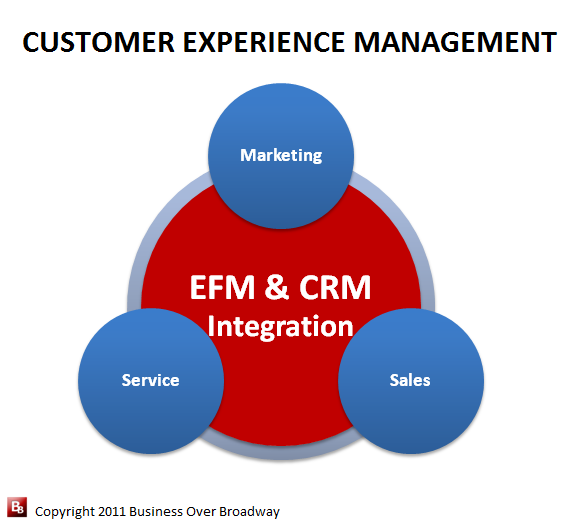
A successful customer experience management (CEM) program requires the collection, synthesis, analysis and dissemination of different types of business metrics, including operational, financial, constituency and customer metrics (see Figure 1). The quality of customer metrics necessarily impacts your understanding of how to best manage customer relationships to improve the customer experience, increase customer loyalty and grow your business. Using the wrong customer metrics could lead to sub-optimal decisions while using the right customer metrics can lead to good decisions that give you a competitive edge. How do you know if you are using the right customer metrics in your CEM program? This post will help formalize a set of standards you can use to evaluate your customer metrics.
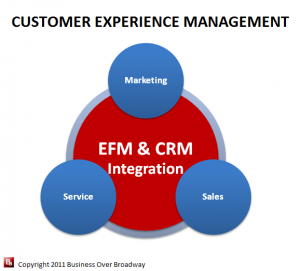
Figure 1. Customer experience management is about collection, synthesis, analysis and dissemination of business metrics.
How CasinosNeteller Explains Neteller’s Role in New Zealand Online Gambling
New Zealand’s online gambling landscape has undergone significant structural change over the past decade, shaped by regulatory ambiguity, shifting consumer behavior, and the growing influence of international payment processors. Among the financial tools that have become embedded in how New Zealanders fund and withdraw from offshore gambling platforms, Neteller occupies a particularly well-established position. Understanding how this payment system functions within the specific context of New Zealand requires looking at both the regulatory environment that governs online gambling in the country and the practical mechanics of how Neteller integrates with the platforms that serve Kiwi players.
The Regulatory Framework Shaping Online Gambling in New Zealand
New Zealand’s gambling legislation is anchored primarily in the Gambling Act 2003, a statute that was written before smartphone-based online gambling existed in any meaningful form. The Act established the Gambling Commission, created a tiered licensing structure for land-based gambling, and explicitly prohibited the operation of online casinos from within New Zealand’s borders. However, the legislation contains a critical gap: it does not prohibit New Zealand residents from accessing and wagering at offshore-licensed online casinos. This distinction — between operating and participating — has created a de facto open market for international gambling platforms targeting Kiwi players.
The Offshore Racing and Sports Betting Act 2009 added some additional provisions, but the fundamental ambiguity around online casino gambling remained. As of the mid-2020s, the New Zealand government has discussed reform on multiple occasions, including a 2021 review of the Gambling Act that acknowledged the limitations of the existing framework in addressing online gambling. Despite these discussions, no comprehensive legislation specifically regulating offshore online casino access has been enacted. This means that New Zealand players continue to use platforms licensed in jurisdictions such as Malta (under the Malta Gaming Authority), Gibraltar, the Isle of Man, and Curaçao, among others.
For payment processors like Neteller, this regulatory environment creates a nuanced operating context. Neteller is not facilitating illegal activity when New Zealand residents use it to fund offshore gambling accounts, because no law explicitly criminalizes that participation. At the same time, Neteller must comply with its own licensing obligations under UK Financial Conduct Authority oversight — it holds an e-money institution license — and must apply anti-money laundering and know-your-customer protocols regardless of where its users are located. This dual compliance framework shapes how Neteller functions specifically for New Zealand users and why certain transaction limits or verification requirements apply.
How Neteller Became Embedded in the New Zealand Online Gambling Market
Neteller was founded in Canada in 1999 and initially grew its user base almost entirely through online gambling transactions. By the early 2000s, it had become one of the primary payment rails for online poker and casino platforms globally. Its acquisition by Optimal Payments (later rebranded as Paysafe Group) in 2015 brought it under more formalized corporate governance, but the core function — providing a digital wallet that intermediates between a user’s bank account and online merchants — remained unchanged.
For New Zealand players, Neteller gained traction for several interconnected reasons. First, New Zealand banks have historically applied restrictions on direct credit or debit card transactions to gambling platforms. While the degree of blocking varies by institution, players at ANZ, Westpac, ASB, and BNZ have reported inconsistent success rates when attempting direct card payments to offshore casino sites. Neteller sidesteps this issue by classifying the initial bank-to-wallet transfer differently from the subsequent wallet-to-casino transfer, which means the transaction category that triggers bank-level restrictions is often bypassed entirely.
Second, Neteller supports the New Zealand dollar (NZD) as a native currency, which eliminates foreign exchange conversion fees that would otherwise apply when funding accounts denominated in euros or British pounds. This is a non-trivial cost consideration for regular players, as currency conversion fees from traditional banks can range from 1.5% to 3.5% per transaction. Neteller’s internal NZD support allows users to hold a balance in their local currency and transfer it directly to NZD-denominated casino accounts where available, or convert at Neteller’s own rates when the casino operates in a different base currency.
Third, withdrawal speed has been a persistent differentiator. Bank wire transfers from offshore casino accounts to New Zealand bank accounts can take between three and seven business days and sometimes trigger additional scrutiny from receiving banks. Neteller withdrawals, by contrast, are typically processed to the e-wallet within 24 to 48 hours of the casino initiating the transfer, and subsequent transfers from the Neteller wallet to a linked bank account take an additional one to two business days. The total cycle is meaningfully faster, which matters to players who treat their gambling bankroll as a managed financial resource rather than a one-way expenditure.
Resources like https://www.casinos-neteller.com/ document which specific casino platforms accept Neteller deposits and withdrawals from New Zealand, providing a practical reference for players navigating a market where payment method availability can differ significantly between operators even when those operators are licensed under the same regulatory authority.
Transaction Mechanics, Fees, and Account Verification Requirements
Understanding how Neteller actually processes transactions is important for New Zealand users because the fee structure is not uniform across all use cases. Deposits into a Neteller account from a New Zealand bank via bank transfer are generally free, though processing times can be two to three business days. Deposits made via debit card carry a fee that has historically ranged between 1.75% and 2.5% of the transaction value. Once funds are inside the Neteller wallet, transferring to a casino account that accepts Neteller is free for standard members, though Neteller’s VIP program — which tiers users based on annual transaction volume — offers reduced fees and enhanced limits at higher membership levels.
The VIP structure is particularly relevant for higher-volume players. At the base level, Neteller accounts have a monthly transfer limit of approximately $7,500 USD equivalent. VIP Bronze, Silver, Gold, Platinum, and Diamond tiers progressively increase these limits, with Diamond-tier members able to transact at significantly higher monthly volumes. Reaching higher VIP tiers requires sustained transaction activity, which creates a self-reinforcing dynamic where frequent gamblers benefit from progressively better terms the more they use the platform.
Account verification is mandatory for New Zealand users who wish to access full functionality. Neteller’s KYC process requires government-issued photo identification (a New Zealand passport or driver’s license is accepted) and proof of address dated within the last three months. This verification step must be completed before withdrawal limits are unlocked and before certain higher-value deposit methods become available. The verification process is conducted digitally and typically resolves within one to three business days, though more complex cases can take longer if documentation is unclear or if additional source-of-funds information is requested.
It is also worth noting that Neteller maintains a separate product called Net+ that functions as a prepaid Mastercard linked to the Neteller wallet. New Zealand users can request a Net+ card, which allows them to spend their Neteller balance at any Mastercard-accepting merchant, including online retailers and services that are not gambling-related. This feature effectively allows the Neteller wallet to function as a secondary spending account, not just a gambling-specific payment tool. However, the Net+ card is subject to its own fee schedule, including a monthly maintenance fee and ATM withdrawal charges, which users should review before applying.
Neteller’s Position Relative to Other Payment Methods in the New Zealand Market
Neteller does not operate in isolation. New Zealand players who use offshore gambling platforms have access to a range of payment options, and understanding where Neteller sits relative to alternatives helps clarify when it is the appropriate choice and when other methods might serve better.
POLi is a bank-integrated payment system widely used in New Zealand that allows direct bank transfers without requiring card details. It has historically been accepted by some offshore gambling platforms as a deposit method, though its acceptance has narrowed over time as some operators removed it from their payment options. POLi does not support withdrawals, which limits its utility as a standalone payment solution for gambling.
PayPal, while dominant in e-commerce globally, has a more restricted relationship with gambling merchants. PayPal’s terms of service prohibit its use for gambling transactions in many jurisdictions, and while there are some licensed gambling operators in specific markets where PayPal is permitted, New Zealand players generally find PayPal unavailable for offshore casino transactions. This creates a gap that Neteller, along with its Paysafe stablemate Skrill, fills effectively.
Skrill and Neteller are frequently compared because they are owned by the same parent company and serve similar functions. The primary differences lie in fee structures, VIP program terms, and merchant acceptance. Some casinos accept one but not the other, and the fee for converting between currencies differs between the two platforms. CasinosNeteller, as a resource focused specifically on Neteller’s role in online gambling, tends to focus on the distinctions that matter most to players choosing between these two options within the same operator’s payment menu.
Cryptocurrency has emerged as an increasingly common payment method at offshore gambling platforms, and a subset of New Zealand players use Bitcoin, Ethereum, or stablecoins like USDT to fund casino accounts. Cryptocurrency transactions offer pseudonymity, fast processing, and no bank-level restrictions, but they introduce price volatility risk (for non-stablecoin assets), require a degree of technical familiarity, and are not universally accepted. Neteller remains the preferred choice for players who want the speed and privacy advantages of an e-wallet without the complexity of managing a cryptocurrency wallet and the associated tax reporting implications, which the New Zealand Inland Revenue Department has clarified apply to cryptocurrency gains.
Prepaid vouchers, particularly Paysafecard, represent another category of payment tool used by some New Zealand gamblers. Paysafecard allows users to purchase a voucher with cash at a retail outlet and redeem it online without linking any bank account or personal financial information. However, Paysafecard does not support withdrawals, and the denomination limitations of physical vouchers make it impractical for larger transactions. CasinosNeteller’s documentation of Neteller’s role in the market implicitly contrasts it with these voucher-based options by highlighting Neteller’s bidirectional functionality — both deposits and withdrawals are supported, which is a meaningful operational advantage.
The broader pattern that emerges from examining the New Zealand online gambling payment ecosystem is that Neteller occupies a middle tier: more flexible and withdrawal-capable than bank cards that get blocked or prepaid vouchers that only work one way, but more familiar and less technically demanding than cryptocurrency. For the segment of New Zealand players who gamble regularly enough to justify the verification process and who value both deposit convenience and withdrawal reliability, Neteller represents a pragmatic choice that has maintained its relevance despite the proliferation of alternatives over the past decade.
New Zealand’s online gambling payment landscape will continue to evolve as the government considers regulatory reform and as global payment infrastructure develops. Neteller’s longevity in this market — spanning more than two decades of operation in a sector characterized by rapid change — reflects the degree to which its core value proposition aligns with what regular online gambling participants actually need: a stable, regulated, bidirectional payment intermediary that functions reliably across a wide range of licensed offshore platforms. For New Zealand players navigating this environment, understanding both the regulatory context and the technical mechanics of tools like Neteller is foundational to making informed decisions about how they manage their gambling finances.
Customer Metrics
Customer metrics are numerical scores or indices that summarize customer feedback results. They can be based on either customer ratings (e.g., average satisfaction rating with product quality) or open-ended customer comments (via sentiment analysis). Additionally, customer ratings can be based on a single item or an aggregated set of items (averaging over a set of items to get a single score/metric).
Meaning of Customer Metrics
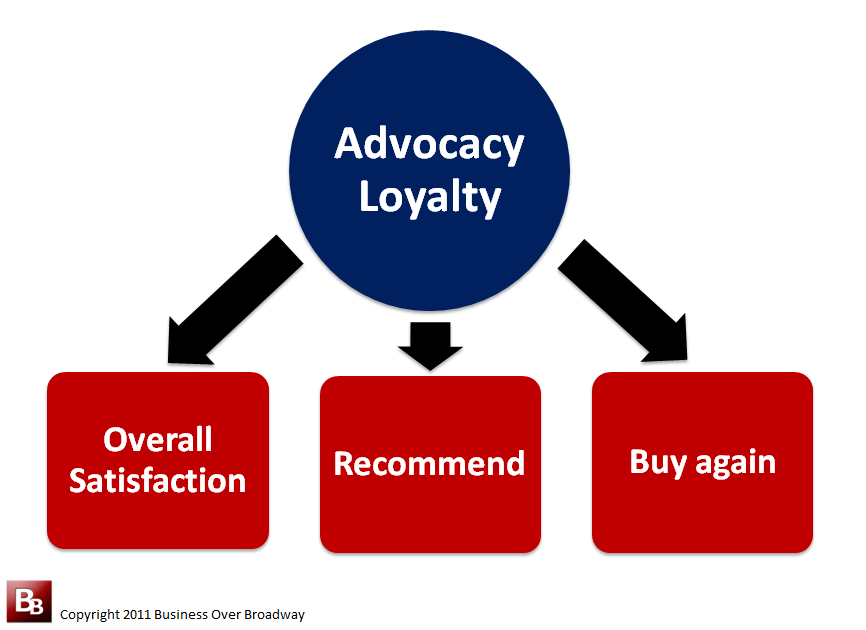
Customer metrics represent more than just numerical scores. Customer metrics have a deeper meaning, representing some underlying characteristic/mental processes about your customers: their opinions and attitudes about and intentions toward your company or brand. Figure 2 depicts this relationship between the feedback tool (questions) and the this overall score that we label as something. Gallup claims to measure customer engagement (CE11) using 11 survey questions. Other practitioners have developed their unique metrics that assess underlying customer attitudes/intentions. The SERVQUAL method assesses several dimensions of service quality; the RAPID Loyalty approach measures three types of customer loyalty: retention, advocacy and purchasing. The Net Promoter Score® measures likelihood to recommend.
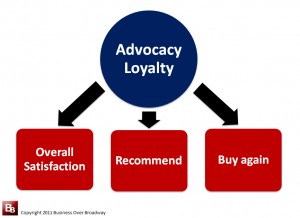
Figure 2. Advocacy Loyalty Index (customer metric) measures extent to which customers will advocate/ feel positively toward your company (underlying construct) using three items/questions.
Customer Metrics are Necessary for Effective CEM Programs but not Frequently Used
Loyalty leading companies compared to their loyalty lagging counterparts, adopt specific customer feedback practices that require the use of customer metrics: sharing customer results throughout the company, including customer feedback in company/executive dashboards, compensating employees based on customer feedback, linking customer feedback to operational metrics, and identify improvement opportunities that maximize ROI.
Despite the usefulness of customer metrics, few businesses gather them. In a study examining the use of customer experience (CX) metrics, Bruce Temkin found that only about half (52%) of businesses collect and communicate customer experience (CX) metrics. Even fewer of them review CX metrics with cross-functional teams (39%), tie compensation to CX metrics (28%) or make trade-offs between financial and CX metrics (19%).
Evaluating Your Customer Metrics
As companies continue to grow their CEM programs and adopt best practices, they will rely more and more on the use of customer metrics. Whether you are developing your own in-house customer metric or using a proprietary customer metric, you need to be able to critically evaluate them to ensure they are meeting the needs of your CEM program. Here are four questions to ask about your customer metrics.
1. What is the definition of the customer metric?
Customer metrics need to be supported by a clear description of what it is measuring. Basically, the customer metric is defined the way that words are defined in the dictionary. They are non-ambiguous and straightforward. The definition, referred to as the constitutive definition, not only tells you what the customer metric is measuring, it also tells you what the customer metric is not measuring.
The complexity of the definition will match the complexity of the customer metric itself. Depending on the customer metric, definitions can reflect a narrow concept or a more complex concept. For single-item metrics, definitions are fairly narrow. For example, a customer metric based on the satisfaction rating of a single overall product quality question would have the following definition: “Satisfaction with product quality”. For customer metrics that are made up of several items, a well-articulated definition is especially important. These customer metrics measure something more nuanced than single-item customer metrics. Try to capture the essence of the commonality shared across the different items. For example, if the ratings of five items about the call center experience (e.g., technical knowledge of rep, professionalism of rep, resolution) are combined into an overall metric, then the definition of the overall metric would be: “Overall satisfaction with call center experience.”
2. How is the customer metric calculated?
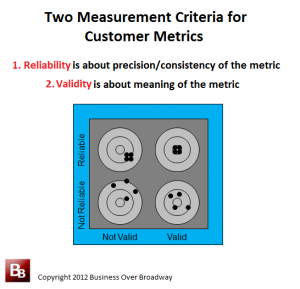
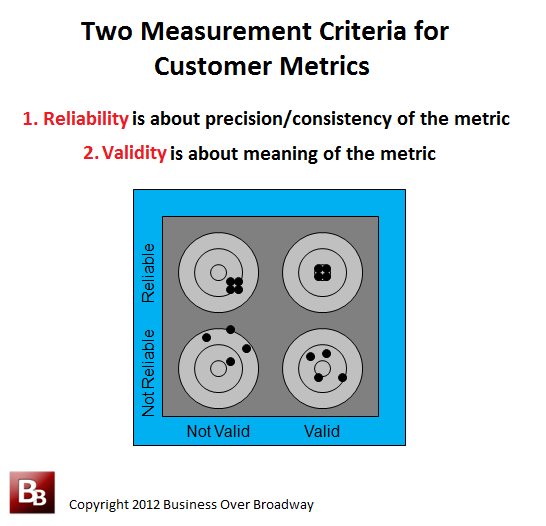
Figure 3. Two Measurement Criteria: Reliability is about precision; Validity is about meaning
Closely related to question 1, you need to convey precisely how the customer metric is calculated. Understanding how the customer metric is calculated requires understanding two things: 1) the specific items/questions in the customer metric; 2) how items/questions were combined to get to the final score. Knowing the specific items and how they are combined help define what the customer metric is measuring (operational definition). Any survey instructions and information about the rating scale (numerical and verbal anchors) need to be included.
3. What are the measurement properties of the customer metric?
Measurement properties refer to a scientifically-derived indices that describe the quality of a customer metric. Applying the field of psychometrics and scientific measurement standards (Standards for Educational and Psychological Testing), you can evaluate the quality of customer metrics. Analyzing existing customer feedback data, you are able to evaluate customer metrics along two criteria: 1) Reliability and 2) Validity. Reliability refers to measurement precision/consistency. Validity is concerned with what is being measured. Providing evidence of reliability and validity of your customer metrics is essential towards establishing a solid set of customer metrics for your CEM program. The relationship between these two measurement criteria is depicted in Figure 3. Your goal is to develop/select customer metrics that are both reliable and valid (top right quadrant).
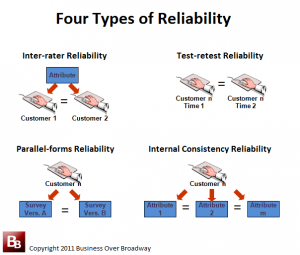
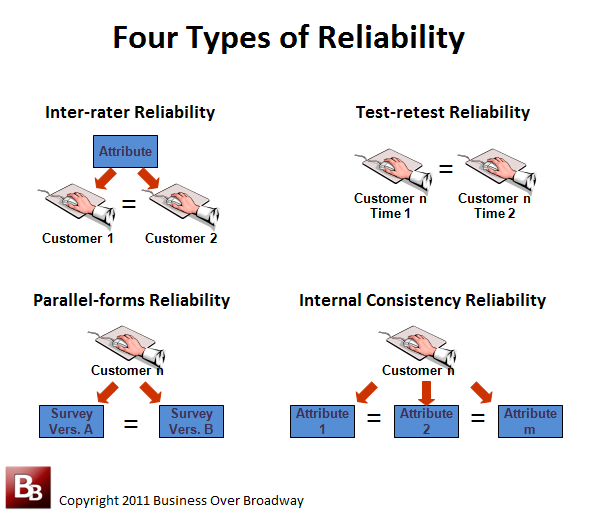
Figure 4. Four Types of Reliability
While there are different kinds of reliability (see Figure 4), one in particular is especially important when the customer metric is made up of multiple items (e.g., most commonly, items are averaged to get one overall metric). Internal consistency reliability is a great summary index that tells you if the items should combined together. Higher internal consistency (above .80 is good; 1.0 is the maximum possible) tells you that the items measure one underlying construct; aggregating them makes sense. Low internal consistency tells you that the items are likely measuring different things and should not be aggregated together.
There are three different lines of validity evidence that help show that the customer metric actually measures what you think it is measuring. To establish that a customer metric assesses something real, you can look at the content of the items to determine how well they represent your variable of interest (establishing evidence of content validity), you can calculate how well the customer metric correlates with some external criteria (establishing evidence of criterion validity) and you can understand, through statistical relationships among different metrics, how your customer metric fits into a theoretical framework that distinguishes your customer metric from other customer metrics (e.g., How is the customer engagement metric different than the customer advocacy metric? – construct validity).
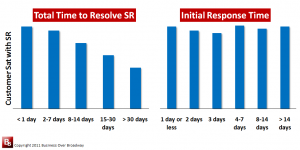
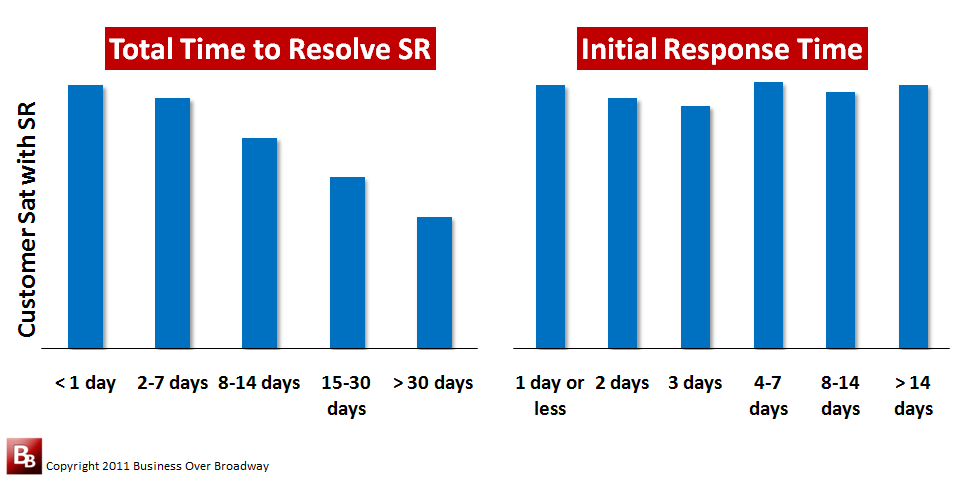
Figure 5. Evidence of criterion-related validity: Identifying which operational metrics are related to customer satisfaction with the service request (SR)
These three different lines of validity evidence demonstrate that the customer metric measures what it is intended to measure. Criterion-related validity evidence often involves linking customer metrics to other data sources (operational metrics, financial metrics, constituency metrics).
Exploring the reliability and validity of your current customer metrics has a couple of extra benefits. First, these types of analyses can improve the measurement properties of your current customer metrics by identifying unnecessary questions. Second, reliability and validity analysis can improve the overall customer survey by identifying CX questions that do not help explain customer loyalty differences. Removal of specific CX questions can significantly reduce survey length without loss of information.
4. How useful is the customer metric?
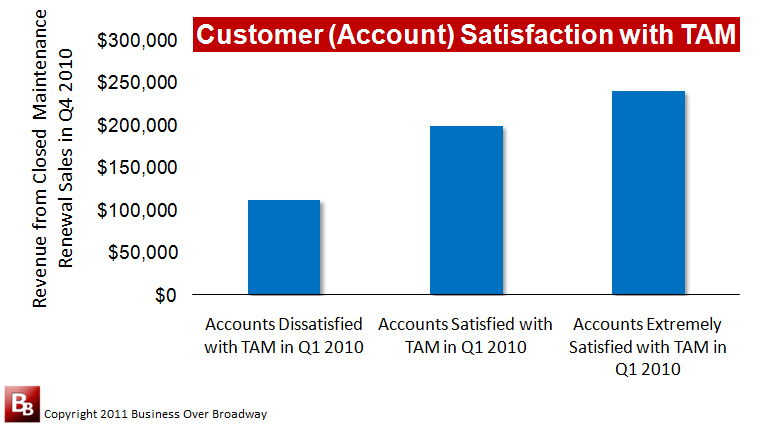
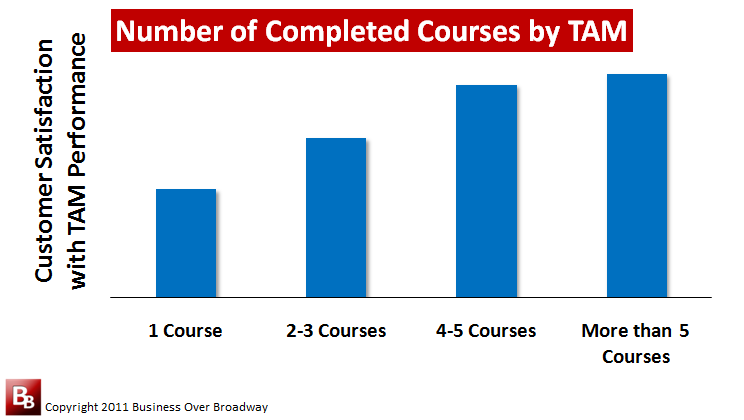
While customer metrics can be used for many types of analyses (e.g., driver, segmentation), their usefulness is demonstrated by the number and types of insights they provide. Your validation efforts to understand the quality of the customer metrics create a practical framework for making real organizational changes. Specifically, by understanding the causes and consequences of the customer metric, you can identify/create customer-centric operational metrics (See Figure 5) to help manage call center performance, understand how changes in the customer metric correspond to changes in revenue (See Figure 6) and identify customer-focused training needs and standards for employees (See Figure 7).
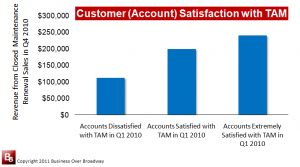
Figure 6. A useful customer metric (satisfaction with TAM) reveals real differences in business metrics (revenue)
Examples
Below are two articles on the development and validation of four customer metrics. One article focuses on three related customer metrics. The other article focuses on an employee metric. Even though this present blog post talked primarily about customer metrics, the same criteria can be applied to employee metrics.
In each article, I present the necessary information needed to critically evaluate each customer metric: 1) Clear definition of the customer metrics, 2) description of how metrics are calculated, 3) measurement properties (reliability/validity), 4) show that metrics are related to important outcomes (e.g., revenue, employee satisfaction). The articles are:
- Hayes, B.E. (2011). Lessons in loyalty. Quality Progress, March, 24-31. Paper discusses the development and validation of the RAPID Loyalty approach. Three reliable customer loyalty metrics are predictive of different types of business growth. Read entire article.
- Hayes, B. E. (1994). How to measure empowerment. Quality Progress, 27(2), 41-46. Paper discusses need to define and measure empowerment. Researcher develops reliable measure of employee perceptions of empowerment, the Employee Empowerment Questionnaire (EEQ). The EEQ was related to important employee attitudes (job satisfaction). Read entire article.

Figure 7. Evidence of Criterion-Related Validity: Satisfaction with TAM Performance (customer metric) is related to TAM training.
Summary
A customer metric is good when: 1) it is supported with a clear definition of what it measures and what is does not measure; 2) there is a clear method of how the metric is calculated, including all items and how they are combined; 3) there is good reliability and validity evidence regarding how well the customer metric measures what it is supposed to measure; 4) they are useful in helping drive real internal changes (e.g., improved marketing, sales, service) that lead to measurable business growth (e.g., increased revenue, decreased churn).
Using customer metrics that meet these criteria will ensure your CEM program is effective in improving how your manage the customer relationship. Clear definitions of the metrics and accompanying descriptions of how they are calculated help improve communications regarding customer feedback. Different employees, across job levels or roles, can now speak a common language about feedback results. Establishing the reliability and validity of the metrics gives senior executives the confidence they need to use customer feedback as part of their decision-making process.
The bottom line: a good customer metric provides information that is reliable, valid and useful.




 Beyond the Ultimate Question
 Measuring Customer Satisfaction and Loyalty (3rd Ed.)
[…] is about more than generating numerical figures. You need to be able to distinguish which metrics are most valuable for your business. You also need to know how to use them and what do to do with them when you have […]
[…] You need to understand: 1) how it is defined, 2) how it is calculated, 3) its measurement properties (e.g., reliability and validity) and 4) its usefulness (e.g […]
[…] of the RAPID loyalty indices has excellent measurement properties; that is, each index is a reliable, valid and useful indicator of customer loyalty and is […]
[…] Create Meaningful Patient Metrics. To accomplish this, I will look at many metric simultaneously via a factor analysis. This approach will help me see if I can aggregate/combine some questions together into a single metric (e.g. average all seven patient experience ratings into one metric). The ultimate goal is to create a metric that is reliable, valid and useful. […]
[…] are necessarily fraught with measurement error, I have argued for using psychometrics as a way of evaluating these “soft” metrics. Psychometrics helps you understand the reliability and validity of your loyalty metrics and needs […]
[…] Customer Experience/Loyalty Metrics […]
[…] Customer Experience/Loyalty Metrics […]
[…] measure of customer loyalty when analyzing survey data. While these loyalty metrics do provide reliable, valid and useful information, you are always interested in what customers really do. By linking up financial data and customer […]
[…] Customer Experience/Loyalty Metrics […]
[…] Customer Experience/Loyalty Metrics […]
[…] REVIEW! The Customer Loyalty Factor – Building a More Sales Mindset ## http://www.uawareness.com | kjxpdyvvBusiness Sales | eBook Study Guides.com How to Woo the Modern Customer. – Hidden Peak Interactive5 Top Customer Service Articles For the Week of January 28, 2013 | Shep HykenWhy Customer Experience is on the Sales Director’s Agenda | CustomerFaithfulSolution Selling For Customers With The Challenger Sale | NICWINDLEY.CO.UKFour thing you need to know about your customer metrics. | Business Over Broadway […]
[…] Four Things You Need to Know about Your Customer Metrics: Companies use metrics to track progress. To be effective, these metrics need to be clear, reliable, valid and useful. […]
[…] For a more, in-depth discussion about these four criteria, please see Four Things you Need to Know about Your Customer Metrics. […]
[…] For a more, in-depth discussion about these four criteria, please see Four Things you Need to Know about Your Customer Metrics. […]
[…] are necessarily fraught with measurement error, I have argued for using psychometrics as a way of evaluating these “soft” metrics. Psychometrics helps you understand the reliability and validity of your loyalty metrics and needs […]
[…] measure of customer loyalty when analyzing survey data. While these loyalty metrics do provide reliable, valid and useful information, you are always interested in what customers really do. By linking up financial data and customer […]
[…] measure of customer loyalty when analyzing survey data. While these loyalty metrics do provide reliable, valid and useful information, you are always interested in what customers really do. By linking up financial data and customer […]
[…] them and their customers who take them. Specifically, businesses need customer surveys that provide reliable, valid and useful information to help run the business more effectively. Customers need surveys that let them give quick, yet […]
[…] metric using the four criteria I use when evaluating any metric derived from survey responses (see Four Things You Need To Know About Your Customer Metric): 1) definition of the metric, 2) how metric is calculated (including items and scoring method), 3) […]