
Click image to download CustomerVerse sample report.
CustomerVerse is a customer feedback solution to measure and improve the customer experience. CustomerVerse represents the culmination of over 20 years of research in how to best capture and improve customer satisfaction. The CustomerVerse provides you with useful metrics and information that will help you drive your business forward.
How Betzoid Approaches UEFA Champions League Match Analysis
The UEFA Champions League represents the pinnacle of European club football, drawing together the continent’s elite teams in a competition defined by its unpredictability, tactical complexity, and historical weight. For analysts and enthusiasts seeking to understand match outcomes, the Champions League presents a uniquely challenging environment where squad depth, managerial philosophy, and continental experience intersect in ways that domestic league analysis rarely captures. Betzoid has developed a structured, data-informed approach to breaking down Champions League fixtures that goes beyond surface-level statistics, offering readers a genuinely nuanced understanding of what drives results at the highest level of club football.
The Foundation of Betzoid’s Analytical Framework
At the core of Betzoid’s approach to Champions League analysis lies a commitment to contextual data interpretation rather than raw statistical presentation. While many platforms simply aggregate numbers such as possession percentages, shots on target, and expected goals figures, Betzoid’s methodology emphasizes what those numbers mean within the specific context of a European knockout or group stage encounter. This distinction matters enormously, because Champions League football operates under a different psychological and tactical register than weekend league fixtures.
One of the foundational principles Betzoid applies is the separation of domestic form from European performance history. A team performing exceptionally well in their national league may carry entirely different characteristics when competing across two legs against continental opposition. Historical European records, head-to-head data across UEFA competitions, and the specific tactical adjustments managers make for European nights all factor into the analytical picture. For instance, teams managed by coaches with deep European experience, such as those who have navigated multiple knockout rounds at clubs like Bayern Munich, Real Madrid, or Atlético Madrid, tend to demonstrate measurably different defensive structures in away legs compared to their domestic away performances.
Betzoid also places significant emphasis on squad rotation patterns and their downstream effects. Champions League campaigns run parallel to domestic schedules, and elite clubs frequently rotate personnel to manage physical load. Analysts at Betzoid track which players have been rested ahead of key European fixtures, how a manager’s preferred eleven differs between competitions, and whether a club’s recent fixture congestion creates vulnerabilities in specific positions. This granular attention to squad management reflects an understanding that Champions League outcomes are often decided not by the quality of a club’s best eleven, but by the depth and readiness of their full squad across a congested calendar period.
Another critical element in the analytical framework is venue and atmospheric context. Betzoid recognizes that certain stadiums carry a psychological weight that measurably affects visiting teams. The Bernabéu under floodlights during a knockout tie, Anfield during a European night, or the Allianz Arena during the Bundesliga champions’ home European fixtures all create environmental conditions that influence tactical decision-making and player performance in ways that standard home and away splits do not fully capture. Betzoid’s analysts account for these atmospheric factors by examining how visiting teams have historically performed in specific high-pressure European environments.
Tactical Metrics and Statistical Tools Used in Match Breakdown
Beyond contextual framing, Betzoid employs a sophisticated set of tactical metrics to dissect individual Champions League fixtures. Expected goals models form a baseline, but Betzoid’s analysis extends into expected goals against, pressing intensity metrics, defensive line height, and transitional speed data. These tools allow analysts to identify not just what happened in a match, but why it happened and whether the result reflected the genuine balance of play or statistical variance.
Pressing metrics have become increasingly central to Champions League analysis in the post-Klopp, post-Guardiola era of European football. Teams that execute high-intensity pressing systems in domestic football sometimes find those systems disrupted against technically superior opposition at the European level. Betzoid tracks PPDA, or passes allowed per defensive action, as a measure of pressing effectiveness, and compares a team’s European PPDA figures against their domestic equivalents to identify whether their pressing game translates across competitive levels. This kind of cross-competition comparison reveals meaningful insights that would be invisible to analysts relying solely on domestic form data.
Defensive line analysis is another area where Betzoid’s approach demonstrates genuine depth. In Champions League football, the management of space behind the defensive line becomes critical because the attacking quality of opposition forwards, players like Erling Haaland, Kylian Mbappé, or Vinicius Júnior, means that even small errors in line positioning can be catastrophically punished. Betzoid examines how teams adjust their defensive structure when facing opponents with elite pace and movement, tracking whether managers shift to a deeper block or maintain their standard high defensive line, and what the statistical outcomes of those choices have been historically.
Set piece analysis also features prominently in Betzoid’s Champions League breakdowns. Research across European football consistently demonstrates that set pieces account for a significant proportion of goals at the highest level, with some studies suggesting that between 25 and 30 percent of Champions League goals originate from dead ball situations. Betzoid examines both attacking and defensive set piece organization, identifying which teams have invested in structured routines and which carry vulnerabilities from corners, free kicks, and throw-ins in advanced positions. Readers who want to explore UEFA Champions League match analysis through a data-driven lens will find that Betzoid’s treatment of set pieces offers a level of detail that distinguishes it from more generalist football coverage.
Player availability and injury tracking represent another pillar of Betzoid’s pre-match analysis. The absence of a key creative midfielder or a first-choice goalkeeper in a Champions League knockout tie can fundamentally alter the expected competitive balance of a fixture. Betzoid maintains updated injury and suspension records and integrates this information directly into match previews, ensuring that statistical models are adjusted to reflect the actual personnel likely to take the field rather than theoretical full-strength lineups.
Historical Trends and Pattern Recognition in European Competition
One of the most intellectually compelling aspects of Betzoid’s Champions League analysis is its use of historical trend data to identify recurring patterns across the competition’s modern era. Since the Champions League format was restructured in 1992, sufficient data has accumulated to allow meaningful pattern recognition across different phases of the competition, different managerial eras, and different tactical epochs in European football.
Betzoid’s analysts have identified several historically significant trends that inform their match breakdowns. Away goals, while no longer a tiebreaker following UEFA’s 2021 rule change, shaped decades of tactical behavior in European football, and the residual tactical habits formed during that era continue to influence how managers approach two-legged ties. Teams that were historically conservative in away legs often continue to display those tendencies even without the formal incentive of the away goals rule, creating exploitable patterns for opponents who understand this behavioral persistence.
The performance of domestic champions from smaller leagues in the group stage represents another area of pattern analysis. Betzoid tracks how teams from leagues outside the traditional top five, clubs from Portugal, the Netherlands, Belgium, and Scotland, tend to perform when grouped against established European powers. The data reveals consistent patterns around the second group stage matchday, where smaller league champions often experience a significant drop in performance quality as the physical and tactical demands of European competition accumulate, a trend that has meaningful implications for understanding group stage dynamics.
Managerial experience curves in European competition also feature in Betzoid’s historical analysis. First-time Champions League managers, regardless of their domestic credentials, consistently show measurable performance gaps compared to experienced European campaigners in their debut campaigns. This experience premium is particularly pronounced in knockout stages, where the tactical nuances of managing a two-legged tie, including decisions around substitution timing, risk management in the second leg, and squad rotation between legs, require a specific type of knowledge that only repeated exposure to European competition can develop.
Betzoid also examines the performance trajectories of clubs across a single Champions League campaign, tracking how teams evolve tactically and physically from the group stage through to the knockout rounds. Clubs that peak tactically in February and March, when the round of sixteen is contested, often show different characteristics than those that build momentum progressively. Understanding where a team sits on its seasonal performance curve at the moment of a specific fixture adds another layer of analytical precision to match previews.
Translating Analysis into Meaningful Reader Understanding
The ultimate measure of any analytical platform’s value is whether its analysis genuinely improves the reader’s understanding of the sport. Betzoid approaches this challenge by structuring its Champions League content in a way that serves both casual followers seeking context and more engaged readers looking for detailed tactical and statistical insight. This dual-audience approach requires careful editorial judgment about which information to foreground and which to present as supplementary depth.
Match previews produced by Betzoid typically open with a narrative framing of the fixture’s significance within the broader competition context, establishing stakes before introducing statistical evidence. This sequencing reflects an understanding that data is most persuasive when readers already appreciate why a particular match matters. Following the narrative introduction, tactical analysis explores the specific matchup dynamics, identifying key positional battles, likely tactical formations, and the areas of the pitch where the competitive advantage is most likely to be decided.
Post-match analysis on Betzoid follows a similarly structured approach, revisiting pre-match predictions against actual outcomes and examining where the analytical model accurately anticipated events and where reality diverged from expectation. This reflective practice serves an important educational function, demonstrating to readers that even sophisticated analysis operates within the bounds of genuine uncertainty, and that the value of analytical frameworks lies in improving probabilistic understanding rather than guaranteeing specific outcomes.
The integration of visual data representation, including heat maps, passing network diagrams, and progressive carry charts, further enhances the accessibility of Betzoid’s Champions League analysis. These visual tools translate complex spatial and movement data into immediately comprehensible formats, allowing readers to grasp tactical patterns that would require significant technical expertise to extract from raw data alone. By combining rigorous statistical methodology with accessible presentation, Betzoid has developed an analytical voice that respects the intelligence of its audience while remaining genuinely informative rather than obscurantist.
In conclusion, Betzoid’s approach to UEFA Champions League match analysis reflects a sophisticated understanding of what makes European football analytically distinct from domestic competition. By combining contextual data interpretation, advanced tactical metrics, historical trend recognition, and accessible presentation, Betzoid offers readers a genuinely valuable framework for understanding the competition’s complexity. The platform’s commitment to intellectual rigor, combined with its attention to the human and historical dimensions of European football, positions it as a serious analytical resource for anyone seeking to deepen their understanding of the Champions League beyond what surface-level coverage can provide.
In our research into different survey approaches, we found that you can learn a lot about your customers by asking them these two questions:
- What one word best describes Company Name?
- If you were in charge of Company Name, what improvements, if any, would you make?
Using our proprietary sentiment lexicons and algorithms, we can extract useful information from your customers’ responses to help you improve the quality of the customer relationship. Based on these two questions, you will be able to understand, track and improve customer sentiment.
The Insights You Need to Grow Your Business

Word Cloud of Customers’ Words. Click image to enlarge.
CustomerVerse provides you with a summary report that includes:
- Word Cloud of customers’ responses – This summary provides a high-level picture of how customers describe you. Not only do these words provide you insight as to what is driving customer satisfaction, they can also be used to augment marketing collateral.
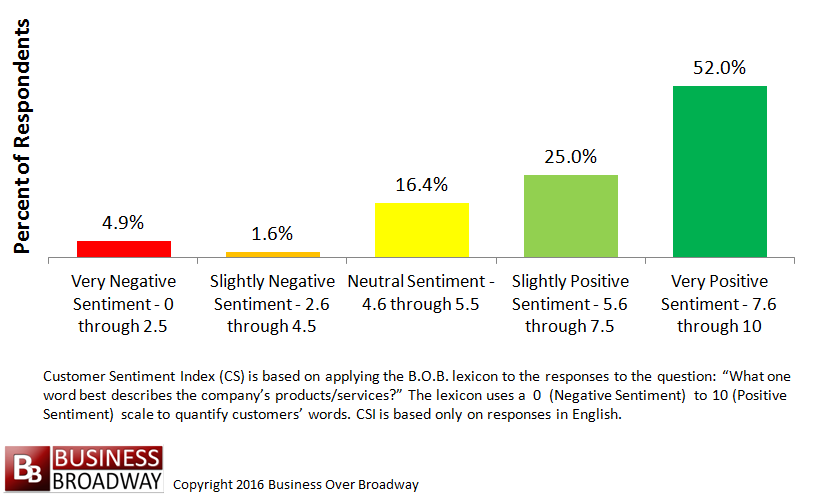
Understand your customers’ attitudes using our Customer Sentiment Index. Click image to enlarge.
-
Customer Sentiment Index – Using our proprietary sentiment lexicon algorithm, we translate customers’ words into numerical values that reflect your customers’ sentiment/attitude toward you and your brand. Use this metric to track customer satisfaction over time.
-
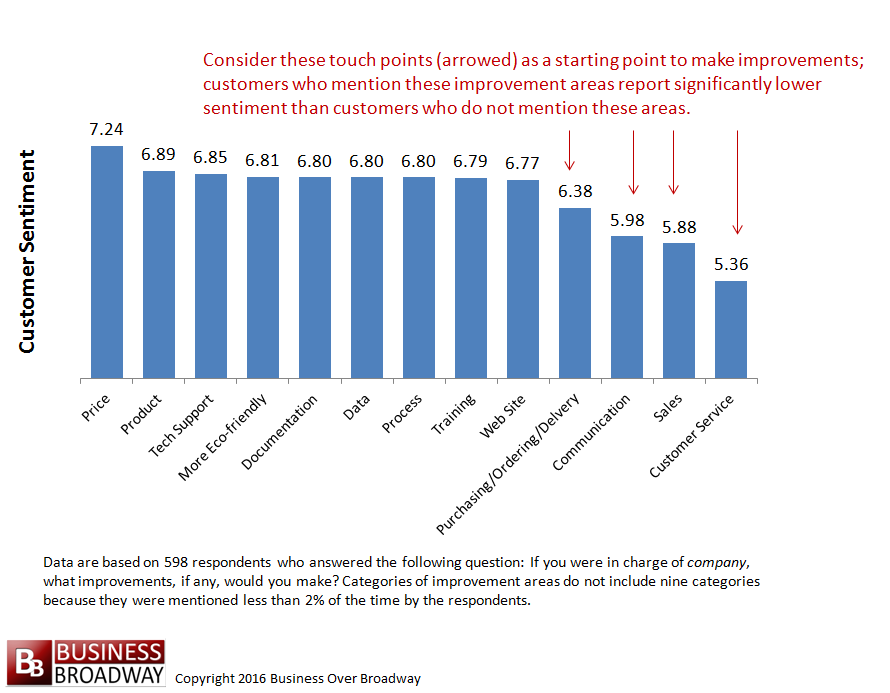
Invest in the right areas to grow your business. Click image to enlarge.
Customer Experience Improvement Areas – When you make improvements to your business, you want to ensure you are investing in the right areas that will increase customer satisfaction and loyalty. Our analysis will tell you which improvement areas will have the largest return on investment.
Why Use CustomerVerse?
There are five primary benefits to using CustomerVerse. The CustomerVerse helps you:
- Save money. CustomerVerse is a cost-effective way to understand your customers needs.
- Obtain reliable, valid and useful information about your customers. Insights gleaned from the CustomerVerse are comparable to longer surveys.
- Hear from more of your customers. Shorter surveys have higher response rates.
- Minimize customer effort. CustomerVerse provides customers a quick and easy way to tell you what you need to do to win their business. Respect your customers’ time.
- Identify operational best practices, track sentiment and understand customer segments. Using our proprietary Customer Sentiment Index, you will be able to test hypotheses about your customers.
Customers who are happier with your products and service will recommend you to their friends, purchase different types of products from you and will be around for the long-term. Find out how your customers feel about you with CustomerVerse and start growing your business.
For more information, you can contact me by completing the form below.
[si-contact-form form=’1′]

 Beyond the Ultimate Question
 Measuring Customer Satisfaction and Loyalty (3rd Ed.)