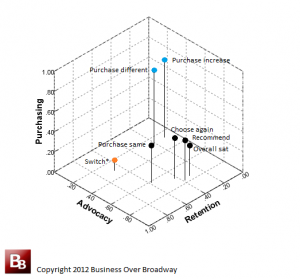
 I use factor analysis (more on that below) often in my customer experience management research. Specifically, I use it to help understand how to best measure customer loyalty. The value of factor analysis, however, is sometimes lost in the details. In this post, I adopt a visual approach in presenting factor-analytic results of some prior research to help show that customer loyalty is really best conceptualized as a multi-dimensional construct, not easily captured using single-item metrics.
Factor Analysis
I will not go into great detail about factor analysis (For those of you who want to learn more, I recommend doing what I did: go to graduate school in a rural area where your options of “fun” are either taking a semester of factor analysis or watching the corn grow. Best environment in which to learn.). In its simplest form, Factor analysis is an excellent data reduction technique. It is used when you have a large number of variables in your data set and would like to reduce the number of variables to manageable size. In general, factor analysis examines the statistical relationships (e.g., correlations) among a large set of variables and tries to explain these correlations using a smaller number of variables (factors).
Hoe AstroPay werkt bij online casino’s volgens Casinosastropay
AstroPay is een betaalmethode die in de afgelopen jaren steeds prominenter aanwezig is geworden in de wereld van online gokken. Oorspronkelijk opgericht in 2009 en gericht op markten in Latijns-Amerika, heeft het bedrijf zijn bereik sindsdien sterk uitgebreid naar Europa, Azië en andere regio’s waar traditionele betaalmethoden niet altijd toegankelijk zijn of waar spelers extra privacy wensen. Het systeem werkt als een prepaid digitale portemonnee die gebruikers in staat stelt om betalingen te doen zonder directe koppeling aan een bankrekening of creditcard. Voor online casino’s biedt dit zowel voordelen voor de operator als voor de speler, wat de populariteit van deze methode grotendeels verklaart.
De technische werking van AstroPay bij stortingen en opnames
AstroPay functioneert op basis van een systeem van virtuele prepaid kaarten en een digitale portemonnee-infrastructuur. Wanneer een gebruiker een account aanmaakt bij AstroPay, krijgt hij of zij toegang tot een persoonlijk dashboard waarmee virtuele kaarten kunnen worden aangemaakt of een saldo kan worden opgebouwd via verschillende lokale betaalmethoden. Dit saldo kan vervolgens worden gebruikt bij online casino’s die AstroPay als betalingsoptie accepteren.
Bij een storting in een online casino selecteert de speler AstroPay als betaalmethode in de kassasectie. Vervolgens wordt hij doorgestuurd naar de AstroPay-omgeving of voert hij de kaartgegevens in die zijn gegenereerd binnen zijn AstroPay-account. De transactie verloopt via het netwerk van AstroPay zelf, wat betekent dat de casino-operator nooit directe toegang heeft tot de bankgegevens van de speler. Dit gelaagde systeem vormt een van de kernvoordelen van de methode vanuit privacyperspectief.
Stortingen via AstroPay worden in de meeste gevallen onmiddellijk verwerkt. Er is geen wachttijd van uren of dagen zoals bij bankoverschrijvingen. Het saldo is direct beschikbaar in het casino, wat spelers in staat stelt zonder vertraging te beginnen met spelen. De minimale stortingsbedragen variëren per casino, maar liggen doorgaans tussen de vijf en tien euro. Maximumlimieten zijn afhankelijk van het verificatieniveau van het AstroPay-account en de specifieke voorwaarden van het casino.
Opnames werken anders dan stortingen, wat een punt van aandacht is voor spelers die AstroPay overwegen. Niet alle casino’s ondersteunen directe uitbetalingen naar een AstroPay-portemonnee. In gevallen waar dit wel mogelijk is, worden winsten teruggestort op het AstroPay-saldo van de speler, van waaruit het geld vervolgens kan worden overgemaakt naar een gekoppelde bankrekening of via andere methoden kan worden opgenomen. De verwerkingstijd voor opnames naar AstroPay varieert doorgaans van enkele uren tot maximaal twee werkdagen, afhankelijk van het casino en de interne verificatieprocedures.
Veiligheid, regulering en verificatieprocedures
AstroPay opereert onder licenties van verschillende financiële toezichthouders wereldwijd. In het Verenigd Koninkrijk staat het bedrijf geregistreerd bij de Financial Conduct Authority (FCA), wat betekent dat het moet voldoen aan strikte eisen op het gebied van cliëntidentificatie, antiwitwasbeleid en kapitaalbescherming. Voor Europese gebruikers is dit een relevante factor, omdat het aangeeft dat de dienst niet opereert in een regulatoire grijze zone.
De verificatieprocedure bij AstroPay volgt de standaard Know Your Customer (KYC) richtlijnen die in de financiële sector worden gehanteerd. Bij het aanmaken van een account is een basisregistratie voldoende voor lagere transactielimieten. Voor hogere limieten of het koppelen van een bankrekening is een volledige identiteitsverificatie vereist, waarbij de gebruiker een geldig identiteitsbewijs en bewijs van adres moet indienen. Dit proces is vergelijkbaar met wat spelers gewend zijn bij online casino’s zelf, die onder de Anti Money Laundering Directive (AMLD) van de Europese Unie verplicht zijn soortgelijke controles uit te voeren.
Wat betreft transactiebeveiliging maakt AstroPay gebruik van SSL-encryptie voor alle datatransmissies en tweefactorauthenticatie als extra beveiligingslaag voor accounttoegang. Virtuele kaarten die worden aangemaakt voor eenmalig gebruik bieden een extra beschermingsniveau: zelfs als de kaartgegevens worden onderschept, kunnen ze niet opnieuw worden gebruikt. Dit maakt het systeem robuuster dan het gebruik van een vaste debit- of creditcard bij online aankopen.
Wat betreft de positie van AstroPay in de bredere context van online casinobetaalmethoden, merken specialisten die de markt nauwkeurig volgen interessante ontwikkelingen op. Zo blijkt volgens onze experts dat het aandeel van e-wallets en prepaid betaalmethoden in de Europese online gokmarkt tussen 2019 en 2023 is gegroeid van ongeveer 28 procent naar meer dan 42 procent van alle transacties, waarbij AstroPay een significant deel van die groei voor zijn rekening neemt in markten buiten de traditionele dominantie van PayPal en Skrill.
Een ander relevant veiligheidsaspect betreft de scheiding van fondsen. AstroPay houdt klantentegoeden gescheiden van de operationele middelen van het bedrijf zelf, wat betekent dat het saldo van gebruikers beschermd is in het geval van financiële problemen bij de dienstverlener. Dit is een standaardvereiste voor e-geldinstituties die opereren onder Europese regelgeving, maar het is een punt dat spelers zelden actief controleren voordat ze een betaalmethode kiezen.
Kosten, limieten en praktische overwegingen voor casinospelers
Een van de vragen die spelers het meest stellen over AstroPay betreft de kosten. Het aanmaken van een AstroPay-account is gratis, en stortingen bij casino’s zijn in de meeste gevallen kosteloos vanuit het perspectief van de speler. Kosten kunnen echter optreden bij het opladen van het AstroPay-saldo, afhankelijk van de gebruikte betaalmethode. Bankoverschrijvingen zijn doorgaans gratis of goedkoop, terwijl het gebruik van creditcards of bepaalde lokale betaalmethoden een kleine verwerkingsvergoeding met zich mee kan brengen.
Bij het omwisselen van valuta rekent AstroPay een wisselkoersmarge aan die varieert afhankelijk van de betrokken valuta’s. Voor Europese spelers die in euro’s werken en bij casino’s spelen die ook in euro’s opereren, is dit doorgaans geen probleem. Spelers die echter bij casino’s spelen die in andere valuta’s werken, of die AstroPay gebruiken in landen met lokale valuta’s, doen er goed aan de actuele wisselkoersen te vergelijken met de marktkoers om de werkelijke kosten te begrijpen.
Casinosastropay heeft in zijn analyses van verschillende casino’s vastgesteld dat de transactielimieten per platform aanzienlijk kunnen variëren. Sommige casino’s hanteren een dagelijks stortingsmaximum van vijfhonderd euro voor AstroPay-gebruikers, terwijl andere platforms limieten van vijfduizend euro of meer toestaan voor geverifieerde gebruikers. Het is dan ook van belang dat spelers de specifieke voorwaarden van het casino nakijken voordat ze AstroPay als primaire betaalmethode instellen.
Een praktische overweging die spelers soms over het hoofd zien, betreft de bonusvoorwaarden bij casino’s. Sommige online casino’s sluiten stortingen via prepaid methoden en e-wallets expliciet uit van welkomstbonussen of andere promoties. Dit beleid is niet universeel, maar het komt voor. Spelers die bonusaanbiedingen willen benutten, doen er verstandig aan de bonusvoorwaarden te lezen voordat ze een storting doen via AstroPay. Dit geldt overigens voor vrijwel alle alternatieve betaalmethoden en is geen uniek nadeel van AstroPay specifiek.
De opname van winsten via AstroPay vereist in de meeste gevallen dat de speler eerder via dezelfde methode heeft gestort. Dit is een standaardpraktijk in de industrie die voortkomt uit antiwitwasregelgeving: casino’s zijn verplicht uitbetalingen bij voorkeur terug te sturen via de oorspronkelijke stortingsmethode. Als het stortingsbedrag volledig is uitbetaald, worden eventuele extra winsten doorgaans via een alternatieve methode zoals bankoverschrijving uitbetaald. Dit proces kan langer duren dan spelers gewend zijn bij direct bankieren.
AstroPay in vergelijking met andere betaalmethoden bij online casino’s
Om AstroPay goed te kunnen plaatsen, is het zinvol het te vergelijken met andere gangbare betaalmethoden in de online casinomarkt. Ten opzichte van traditionele creditcards biedt AstroPay duidelijke privacyvoordelen: er is geen directe link met de bankrekening van de speler, en de transactie verschijnt niet als casinoaankoop op het bankafschrift. Dit is voor veel spelers een relevante overweging, los van eventuele sociale stigma’s rondom gokken.
Vergeleken met gevestigde e-wallets zoals PayPal of Neteller heeft AstroPay als voordeel dat het beschikbaar is in markten waar die diensten beperkt of niet beschikbaar zijn. PayPal heeft zijn casinodiensten in meerdere landen beperkt of volledig teruggetrokken, terwijl Neteller en Skrill na de overname door Paysafe Group hun tarieven hebben verhoogd en hun beschikbaarheid in bepaalde regio’s hebben ingeperkt. AstroPay vult hiermee een marktgat dat is ontstaan door de consolidatie in de sector voor betaaldiensten.
Ten opzichte van cryptovaluta biedt AstroPay minder anonimiteit maar meer stabiliteit en gebruiksgemak. Cryptobetalingen vereisen technische kennis, zijn onderhevig aan koersvolatiliteit en worden niet door alle spelers als toegankelijk ervaren. AstroPay werkt met vaste valutawaarden en vereist geen kennis van blockchain-technologie of digitale portemonnees voor cryptocurrency. Voor de gemiddelde casinospeler die op zoek is naar een alternatief voor directe bankbetalingen is AstroPay daarmee een toegankelijker keuze dan crypto.
Een aspect waarin AstroPay zich onderscheidt van veel concurrenten is de focus op opkomende markten. In landen als Brazilië, Mexico, Argentinië en India heeft AstroPay integraties met lokale betaalmethoden die het mogelijk maken om het saldo op te laden via methoden die voor lokale gebruikers vertrouwd en toegankelijk zijn. Dit maakt de dienst bijzonder relevant voor internationale casino’s die spelers uit diverse markten willen bedienen zonder voor elke markt afzonderlijke betalingsintegraties te moeten implementeren.
Casinosastropay heeft in zijn overzichten van beschikbare betaalmethoden ook de verwerkingssnelheid als vergelijkingspunt meegenomen. Hierbij scoort AstroPay consistent goed voor stortingen, die nagenoeg altijd onmiddellijk worden verwerkt. Voor opnames is het beeld genuanceerder en afhankelijk van het specifieke casino en de interne verwerkingstijden van dat platform.
Samenvattend biedt AstroPay een combinatie van privacy, toegankelijkheid en snelheid die het een relevante betaalmethode maakt voor spelers bij online casino’s. De dienst opereert binnen een gereguleerd kader, biedt solide beveiligingsstandaarden en is beschikbaar in een breed scala aan markten. Spelers die overwegen AstroPay te gebruiken, doen er goed aan de specifieke voorwaarden van hun casino te controleren met betrekking tot stortingslimieten, bonusgeldigheid en opnamemogelijkheden, zodat ze volledig geïnformeerd zijn over de praktische werking van deze betaalmethode in hun specifieke situatie.
While I see great value in factor analysis in helping businesses solve their Big Data problem, factor analysis is essential to helping business understand their survey data (e.g., to create reliable, customer-centric metrics).
The results of the factor analysis are presented in tabular format called the factor pattern matrix. The factor matrix is an NxM table (N = number of original variables and M = number of underlying factors). The elements of a factor pattern matrix represent the regression coefficients (like a correlation coefficient) between each of the variables and the factors. These elements (or factor loadings) represent the strength of relationship between the variables and each of the underlying factors. The results of the factor analysis tells us two things:
- number of underlying factors that describe the initial set of variables
- which variables are best represented by each factor
Measuring Customer Loyalty
Last year, I published an article on the measurement and meaning of customer loyalty (Lessons in Loyalty). In that article, I presented evidence that customer loyalty is really a multidimensional construct. The loyalty questions I used were:
- Overall, how satisfied are you with <Company>? (0 – Extremely dissatisfied to 10 – Extremely satisfied)
- If you were selecting a wireless service provider (personal computer) for the first time, how likely is it that you would choose <Company>? (0 – Not at all likely to 10 – Extremely likely)
- How likely are you to recommend <Company> to your friends/colleagues? (0 – Not at all likely to 10 – Extremely likely)
- How likely are you to continue purchasing the same product and/or service (product) from <Company>? (0 – Not at all likely to 10 – Extremely likely)
- How likely are you to purchase different products and/or services (products) from <Company>? (0 – Not at all likely to 10 – Extremely likely)
- How likely are you to increase the amount of products and/or services (products) you purchase from <Company>? (0 – Not at all likely to 10 – Extremely likely)
- How likely are you to increase the frequency with which you purchase products from <Company>? (0 – Not at all likely to 10 – Extremely likely) (Only used in PC Manufacturer study)
- How likely are you to switch to another provider? (0 – Not at all likely to 10 – Extremely likely) (Only used in Wireless study)
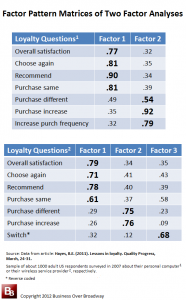
Table 1. Factor pattern matrices of two factor analyses: Top: PC Manufacturers; Bottom: Wireless Service Providers
Factor Pattern Matrix
I conducted two factor analyses of seven (7) different customer loyalty questions, one for the PC industry and the other for the wireless service provider industry, respectively. The factor pattern matrices are presented in Table 1. The results of the factor analyses reveal that the seven loyalty questions can be boiled down to fewer factors, suggesting that the specific loyalty questions really only measure a few types of customer loyalty.
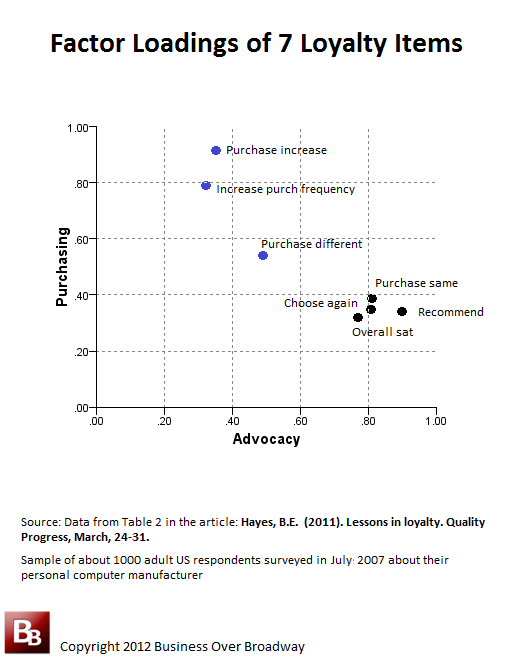
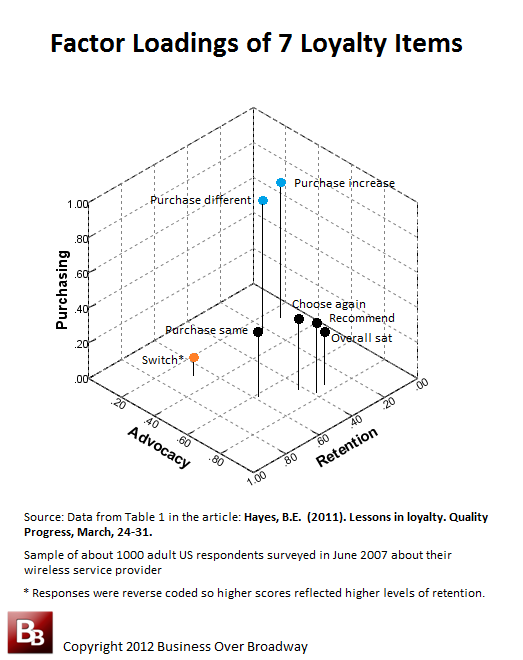
Labeling of factors is part art, part science. The factors are labeled after the number of factors is established. The label needs to reflect the content of the questions that are highly related to it. The first four loyalty questions have similar pattern of factor loadings and measure something I call Advocacy Loyalty; the next set of loyalty questions that have similar factor loadings measure something else (I call it Purchasing Loyalty). And the last loyalty question (for wireless only) measures something different from all other loyalty questions (I call it Retention Loyalty).
Visualizing Customer Loyalty
By plotting the factor loadings of each question in graphical form, we see the location of the items in a factor space (Sounds cool, I know!). This plot is a visual representation of what each question is measuring. You might think of the plot space as the concept of customer loyalty, and where each item falls in this customer loyalty factor space tells us what type of customer loyalty each question is measuring. As they say, a picture is worth a thousand words, and taking a visual approach provides a much more holistic look at the measurement and meaning of customer loyalty (e.g., Which loyalty questions give similar results? Do loyalty questions mean different things across different industries?).
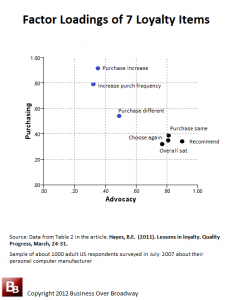
Figure 1. Plot of factor loadings for 7 different customer loyalty questions reveals two general types of customer loyalty
Figure 1 represents the plot (specifically a scatter plot) of the factor loadings from the PC Manufacturers study. Because the factor analysis resulted in only two factors, this plot has only two axes. Advocacy (Factor 1) is the X-axis. Purchasing (Factor 2) is the y-axis. Figure 2 represents a 3-dimensional plot of the factor loadings from the Wireless Service Provider study. The factor analysis revealed a 3-factor solution, so to plot these loyalty questions, we have added an additional z-axis (Retention). Each question is color-coded to reflect the factor on which it has its highest loading (Advocacy questions in black; Purchasing questions in blue; Retention question in orange).
Meaning of Customer Loyalty
Looking at the plots, we can make a few quick judgments about each the customer loyalty questions and customer loyalty:
- There are distinct types of customer loyalty. This series of studies supports the idea that there are three types of customer loyalty: retention, advocacy and purchasing
- Advocacy loyalty reflects a general positive attitude toward the company/brand. Compared to purchasing loyalty, demonstrating advocacy loyalty requires little effort on the part of the customer. Also, the advocacy loyalty questions appear to have elements of purchasing and retention loyalty.
- Purchasing loyalty reflects the customers’ clear intent to deepen the relationship with the company and brand. This extra effort required by the customer differentiates these questions from the standard “purchase same” question. Also, the purchasing loyalty questions are clearly distinct from the other types of customer loyalty (not influenced by advocacy or retention).
- Retention loyalty reflects the customer’s intent to cut ties with the relationship. Similar to purchasing loyalty, retention loyalty, as measured here with the “switching” question, requires a non-trivial amount of effort by the customer.
- Retention and Advocacy loyalty are related yet different. We see that the “switching” question measures something different than the “purchase same” question. Even though poor ratings on either question result in the same outcome (customer is gone), they appear to be tapping different mental processes of the survey taker. Asking somebody if they will stay (purchase same) could be more of a function of the quality of the service/products they are provided and asking somebody if they intend to leave is more of a function of their personal values (price driven customer).
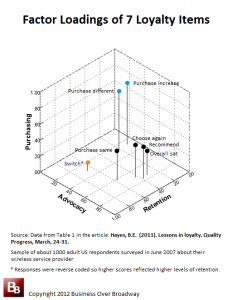
Figure 2. Plot of factor loadings for 7 different customer loyalty questions reveals three general types of customer loyalty
Measuring Customer Loyalty Via Surveys
Customer relationship surveys, the foundation of many customer experience management (CEM) programs, are used to measure customer loyalty, along with other important customer variables (e.g., satisfaction with their experience). Including the right loyalty questions in your customer survey is essential to an effective CEM program.
The Value of Different Customer Loyalty Questions
Including the right customer loyalty questions requires careful thought about your customers and your business. Different types of loyalty questions have been shown to be predictive of different types of business growth. Managing and improving each type of customer loyalty will have a direct impact on revenue. Managing advocacy loyalty will help drive new customer growth. Managing purchasing loyalty will drive existing customer growth by increasing average revenue per user (ARPU). Finally, managing retention loyalty will drive overall size of the customer base.
RAPID Loyalty Approach
These three distinct types of customer loyalty form the foundation of the RAPID loyalty approach. Using the RAPID loyalty’s multi-faceted approach helps companies understand how improving the customer experience can improve business growth in different ways. If interested, you can read my recent article on the development of the RAPID loyalty approach.




 Beyond the Ultimate Question
 Measuring Customer Satisfaction and Loyalty (3rd Ed.)
Hey, I found your articles very illuminating on consumer loyaty. I am researching the link between corporate events and consumer fidelity; more accurately, the activities used by corporate event planning companies and their impact on consumer loyalty. the objective is to find ways to rnder the consumers acquired during an event loyal once the event is over. any thoughts? thank you.
Langha,
Thanks for your question. There are a lot of different types of data you can likely use to answer your question (how do you create loyal customers?) regarding events. One way is to conduct a post-event survey that asks about the participants’ experience at the event. The survey could include the following types of questions: 1) customer loyalty – e.g., likelihood to attend another event; 2) customer experience – e.g., satisfaction with staff; 3) relative performance (e.g., how does this event compare to others you have attended; and 4) event-specific open-ended questions – e.g., list three things could we improve for our next event?).
Generally speaking, your goal is to identify the circumstances under which customers report a high level of loyalty. When you analyze your data, you’re trying to identify the variables are related to customer loyalty; these variables represent the levers by which you increase customer loyalty.