
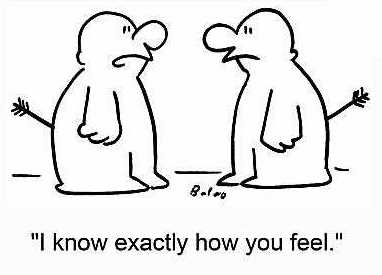

My best friend went on a family vacation and, upon his return home, retold his vacation horror story to me. He was so upset about his treatment by a major airline that he wrote a 4-page letter to them, detailing his displeasure about his experience. The bottom line is that he missed a connecting flight and the airline staff shunned any responsibility to help him.
More importantly, the gate agents lacked any demonstrable empathy towards him about him missing a connecting flight. My friend states in his letter, “The cherry on top was the complete indifference shown to us by both gate agents… Your gate agents in ATL cannot even fake empathy or offer an (ultimately useless) apology.”
He ends the letter this way. “I think you have me down for flying 75,000 Delta miles last year. I bet I have 250,000 miles sitting in my account. I’ll be canceling my Delta AmEx card and using those miles up over the next few years—after all, I earned them the hard way—flying Delta. But otherwise, I’m done.”
Empathy and the Customer Experience
 In its basic form, empathy is defined as the ability to understand and share the feelings of others. Someone who is demonstrating empathy:
- takes the other person’s perspective
- does not judge the person
- recognizes emotion in the other person
- communicates that recognition to the person
In this animated video, Dr. Brené Brown clarifies the meaning of empathy by contrasting it with sympathy.
The gate agents showed no empathy toward my friend. The agents never sought to understand his perspective nor did they acknowledge the hardship he faced. The gate agent was indifferent to his suffering. What could an empathetic response from the gate agent have done? Besides shortening his complaint to 2 pages, it could have prevented him from defecting.
According to Bruce Temkin, “empathy” is the customer experience (CX) word for 2014. He offers a great list of things companies can to encourage employees to show empathy toward their customers, including examining customer journeys, continually reviewing customer feedback (especially verbatim responses) and empowering random acts of kindness.
Here is a humorous account by comedian, John Mulaney, about how is girlfriend saved him from a poor experience with Delta Airlines’ gate agents.
How Slot Volatility Shapes Your Gaming Experience According to Bestcasinoph
When players sit down at a slot machine — whether in a physical casino or through an online platform — they rarely think about the mathematical architecture governing how often and how much they win. Yet this architecture, commonly referred to as volatility or variance, is one of the most consequential factors determining whether a session ends in frustration, steady amusement, or a dramatic windfall. Volatility is not a marketing term or a vague descriptor; it is a measurable statistical property embedded in a game’s design that directly influences the frequency of payouts, the size of those payouts, and the emotional rhythm of play. Understanding how volatility works — and how to use that knowledge when choosing games — can fundamentally change the way a player approaches any slot session.
Defining Volatility and How It Differs from RTP
Volatility and Return to Player (RTP) are two distinct mathematical concepts that are frequently confused, even by experienced gamblers. RTP expresses the theoretical percentage of all wagered money that a slot machine will return to players over an infinite number of spins. A game with a 96% RTP will, in theory, return $96 for every $100 wagered across millions of spins. This figure says nothing, however, about how that $96 is distributed. It could come in the form of hundreds of small wins, or it could arrive as a single enormous jackpot surrounded by long losing streaks. That distribution pattern is what volatility describes.
High-volatility slots pay out less frequently but tend to produce larger individual wins when they do trigger. Low-volatility slots pay out more often but in smaller amounts. Medium-volatility games attempt to balance these two extremes. A game can have a 96% RTP and be either high or low volatility — the RTP tells you the destination, while volatility tells you the road you will travel to get there. This distinction matters enormously for bankroll management. A player with $100 sitting down at a high-volatility game with a 96% RTP may exhaust their entire bankroll before a significant win materializes, even though the long-run math suggests they should recover most of their money. The variance in outcomes over short sessions is simply too wide.
Game developers began formally classifying volatility tiers in the early 2000s as online slots proliferated and players demanded more transparency. Studios like NetEnt, Microgaming, and later Pragmatic Play started including volatility ratings in their game information sheets, though the methodology for calculating these ratings varies between studios. Some use a proprietary index, others rely on hit frequency — the percentage of spins that produce any win at all — as a proxy. A game with a hit frequency of 40% is paying out on nearly half of all spins, which typically signals low volatility. A hit frequency of 15% or lower is more consistent with high-volatility design.
It is worth noting that volatility is not the same as risk in the colloquial sense. A low-volatility game is not necessarily “safer” in terms of total money lost over time — if the RTP is poor, consistent small payouts will still drain a bankroll, just more slowly and less dramatically. The distinction is experiential as much as financial. Volatility shapes the emotional texture of a session: the tension of waiting for a big hit, the comfort of regular small returns, the length of time a given bankroll can sustain active play.
The Mechanics Behind High, Medium, and Low Volatility Design
Slot developers achieve different volatility profiles through several interconnected design decisions. The most fundamental is the paytable structure — specifically, the ratio between the highest and lowest paying symbol combinations. In a high-volatility game, the top symbol combination might pay 5,000 times the bet or more, while the lower-tier combinations pay very little or nothing at all. The mathematical consequence is that most spins yield no return, but the rare alignment of premium symbols produces a payout large enough to justify the long dry spells. Pragmatic Play’s “Gates of Olympus,” released in 2021, is a well-documented example: it carries a maximum win potential of 5,000x the bet and is classified as high volatility, with players often reporting extended sessions without significant returns before a multiplier cascade delivers a large payout.
Bonus feature frequency is another lever. High-volatility games often place their most lucrative mechanics — free spins rounds, expanding wilds, multiplier sequences — behind low-probability triggers. A free spins bonus might activate on average once every 200 spins, but when it does, the feature is engineered to produce outsized results. Low-volatility games, by contrast, may trigger bonus features more frequently but cap the potential multipliers within those features, ensuring the wins are consistent but bounded.
Reel configuration and the number of paylines also contribute. Games with cluster-pay mechanics, where wins are formed by groups of matching symbols rather than fixed lines, often exhibit different volatility characteristics than traditional five-reel, twenty-line setups. The introduction of Megaways mechanics by Big Time Gaming in 2016 — where the number of active paylines changes with every spin, reaching up to 117,649 ways to win — created a new design space for volatility engineering. Most Megaways titles are classified as high volatility because the enormous number of potential winning combinations is offset by complex cascading requirements and low base-game hit frequencies.
Regulatory bodies in several jurisdictions now require game developers to disclose volatility information. The UK Gambling Commission, under its 2019 technical standards update, mandated that operators provide players with accessible information about game variance. Malta Gaming Authority regulations similarly require that game math documentation be available for audit, though public disclosure to players remains inconsistent across markets. In the Philippines, where the online gaming sector has grown substantially since PAGCOR expanded its licensing framework in the mid-2010s, platforms operating under local regulation are increasingly expected to provide transparent game information. Resources like http://bestcasinoph.com/ document the volatility classifications of games available to Filipino players, reflecting a broader regional trend toward informed gambling practices.
How Volatility Affects Bankroll Strategy and Session Planning
Understanding volatility is not merely academic — it has direct, practical implications for how a player should structure their bankroll before any session begins. The core principle is straightforward: the higher the volatility of a game, the larger the bankroll needed to sustain play through losing streaks and reach the statistical range where significant wins become probable. This is not a guarantee of winning; it is a matter of giving the game’s mathematical structure enough time to express itself.
A commonly cited rule among experienced players is that a bankroll of at least 200 to 250 times the base bet is necessary to play a high-volatility slot with reasonable session longevity. For a player betting $1 per spin on a high-volatility game, this means a minimum session bankroll of $200 to $250. At lower volatility, a bankroll of 100 times the base bet may be sufficient to sustain meaningful play. These figures are not derived from any single authoritative source but reflect the practical experience of players and the mathematical reality of variance over short sample sizes.
Bet sizing relative to bankroll is equally important. A player who bets $5 per spin on a high-volatility game with a $100 bankroll is effectively giving themselves only 20 spins before potential ruin — far too few for the game’s variance to smooth out. This is one of the most common mistakes made by players who are drawn to high-volatility games by their jackpot potential but do not adjust their stake size accordingly. The solution is either to reduce bet size or to accept that high-volatility games require a larger initial investment to play in a statistically meaningful way.
Session goals also need to adapt to volatility. Players approaching low-volatility games can reasonably aim to extend playtime and enjoy consistent engagement, accepting modest wins as the primary reward. Those playing high-volatility games should define clear win targets and loss limits before starting, because the swings can be psychologically disorienting. A session that produces a 200x win on spin 180 after 179 losing spins is mathematically within the expected range of a high-volatility game, but experiencing it without prior expectation can feel either euphoric or deeply unsettling depending on the player’s preparation.
Bestcasinoph has noted in its analysis of player behavior in the Philippine market that many players gravitate toward high-volatility games without fully understanding the bankroll implications, often abandoning sessions prematurely before the game’s variance has had time to produce the large wins that motivated their choice. This pattern is consistent with research published by the Journal of Gambling Studies, which has documented a tendency among recreational gamblers to underestimate the role of variance in short-session outcomes and to attribute losing streaks to “bad luck” rather than expected statistical behavior.
Choosing the Right Volatility for Your Playing Style
There is no universally correct volatility level — the appropriate choice depends on a combination of financial circumstances, psychological preferences, and session objectives. A player with a limited budget who wants to enjoy two or three hours of entertainment without risking a rapid bankroll depletion is better served by a low-volatility game, even if the maximum win potential is modest. A player with a larger bankroll who finds frequent small wins tedious and is willing to endure long stretches without significant returns in exchange for the possibility of a life-changing payout is a natural fit for high-volatility titles.
The psychological dimension of this choice deserves serious attention. Research into gambling behavior has consistently shown that near-miss experiences — spins that come close to triggering a bonus or a large win without succeeding — are more emotionally potent in high-volatility games, where the gaps between wins are longer and the anticipation is more intense. This can make high-volatility games more engaging for some personality types and more frustrating or even harmful for others. Players who find themselves chasing losses or feeling compelled to continue after a long losing streak should consider whether high-volatility games are compatible with their psychological relationship with gambling.
Medium-volatility games represent a practical compromise that suits a wide range of players. They offer enough hit frequency to maintain engagement during losing streaks while preserving the possibility of meaningful wins through bonus features. Many of the most commercially successful online slots occupy this middle ground. NetEnt’s “Starburst,” released in 2012 and still among the most-played online slots globally, is classified as low-to-medium volatility with a 96.1% RTP — a combination that has made it a reliable choice for players who prioritize session longevity over jackpot potential.
Game selection platforms and casino review sites have become important resources for players navigating volatility choices. Bestcasinoph, which focuses on the Philippine online gaming market, provides volatility classifications alongside RTP figures and bonus feature descriptions, allowing players to filter games according to their specific preferences rather than relying on visual themes or marketing materials. This kind of structured information is increasingly available across the industry, reflecting a recognition that informed players make more sustainable choices — which benefits both players and operators over the long term.
It is also worth considering how volatility interacts with bonus offers from casinos. Many platforms offer free spins as part of welcome packages or ongoing promotions. Free spins used on high-volatility games carry a higher variance in outcome — a player might exhaust all twenty free spins without a significant win, or might land a large multiplier on the first spin. Low-volatility free spins are more likely to produce consistent, modest returns. When evaluating a bonus offer, the volatility of the designated game matters as much as the number of free spins or the bonus amount, because it determines the realistic range of outcomes a player can expect from the promotion.
Volatility is, ultimately, one of the most underappreciated dimensions of slot game design. It operates invisibly beneath the surface of visual themes, sound design, and marketing narratives, yet it determines more about a player’s actual experience than almost any other factor. A thorough understanding of how volatility works — how it is constructed by developers, how it interacts with bankroll size and session length, and how it maps onto different player preferences — transforms slot gaming from a passive, luck-dependent activity into something that can be approached with genuine strategic awareness. Players who take the time to learn these mechanics are better equipped to choose games that match their goals, manage their money more effectively, and maintain a healthier, more sustainable relationship with the activity overall.

 Beyond the Ultimate Question
 Measuring Customer Satisfaction and Loyalty (3rd Ed.)
Comments are closed.